A Clockwork Orange
1971CrimeDirected by Stanley Kubrick
AI-generated for entertainment purposes only
Own & Stream
Synopsis
"A Clockwork Orange," directed by Stanley Kubrick and released in 1971, is a groundbreaking film that falls under the genres of crime, drama, and sci-fi. Set in a dystopian future, the movie follows the story of Alex DeLarge, played by Malcolm McDowell, a charismatic and violent young delinquent who leads a gang of troublemakers. After a series of heinous crimes, Alex is arrested and subjected to an experimental aversion therapy to cure him of his criminal tendencies. As the narrative unfolds, viewers are taken on a thought-provoking journey that delves into themes of free will, morality, and the consequences of society's attempts to control human behavior. The film's striking visuals, innovative storytelling, and McDowell's mesmerizing performance make "A Clockwork Orange" a cult classic that continues to captivate audiences and spark discussions on the nature of human nature and the ethics of social engineering. With a stellar cast that includes Warren Clarke, Patrick Magee, and Michael Bates, "A Clockwork Orange" remains a timeless cinematic masterpiece that challenges viewers to confront uncomfortable truths about the complexities of the human psyche. Kubrick's direction and the film's haunting soundtrack further contribute to its enduring legacy as a must-watch for fans of thought-provoking cinema.
This synopsis is generated with AI assistance for entertainment purposes only. For official information, please refer to the movie's official sources.
Find Books Inspired by A Clockwork Orange
We've pre-filled the search so you can instantly explore related novels, tie-ins, and thrillers — just hit Find Books!
TML Review
TopMovieList exclusive verdict🏆
Must-Watch Masterpiece
🏆 A must-watch film that excels in all aspects of filmmaking. This cinematic achievement delivers an unforgettable experience.
Collectibles & Reads
Director

Main Cast
4 cast members


F.A.Q.
Q:What unique methods did Stanley Kubrick use to create the disturbing atmosphere in A Clockwork Orange?
A:
Kubrick employed unconventional filmmaking techniques including fast-motion and slow-motion sequences to distort the viewer's perception of time. He also used classical music in jarring juxtaposition with violent scenes to create a disorienting and impactful experience. Additionally, the use of unsettling wide-angle shots contributed to the film's unique visual style.
Q:Were there any significant controversies related to the release of A Clockwork Orange?
A:
Yes, A Clockwork Orange encountered significant controversy and censorship due to its explicit violent and sexual content. It was banned in several countries and even withdrawn from British release by Kubrick himself in 1973 due to allegations that it inspired copycat crimes. The film remained unavailable in the UK until after Kubrick's death in 1999.
Q:How did Malcolm McDowell prepare for his role as Alex DeLarge?
A:
Malcolm McDowell's preparation for Alex DeLarge involved extensive discussions with Kubrick to deeply understand the character's psyche. Interestingly, McDowell improvised one of the film's iconic scenes - singing 'Singing in the Rain' during a violent sequence, which Kubrick decided to include after being inspired by McDowell's spontaneous performance during rehearsals.
The FAQ section is generated with AI assistance for entertainment purposes only. For official information, please refer to the movie's official sources.
Trivia
🎬The infamous 'Ludovico Technique' scenes were extremely strenuous to shoot, with Malcolm McDowell actually having his eyelids clamped open. During one take, a doctor applied anesthetic drops every few seconds to prevent his corneas from drying while filming the intense sequence.
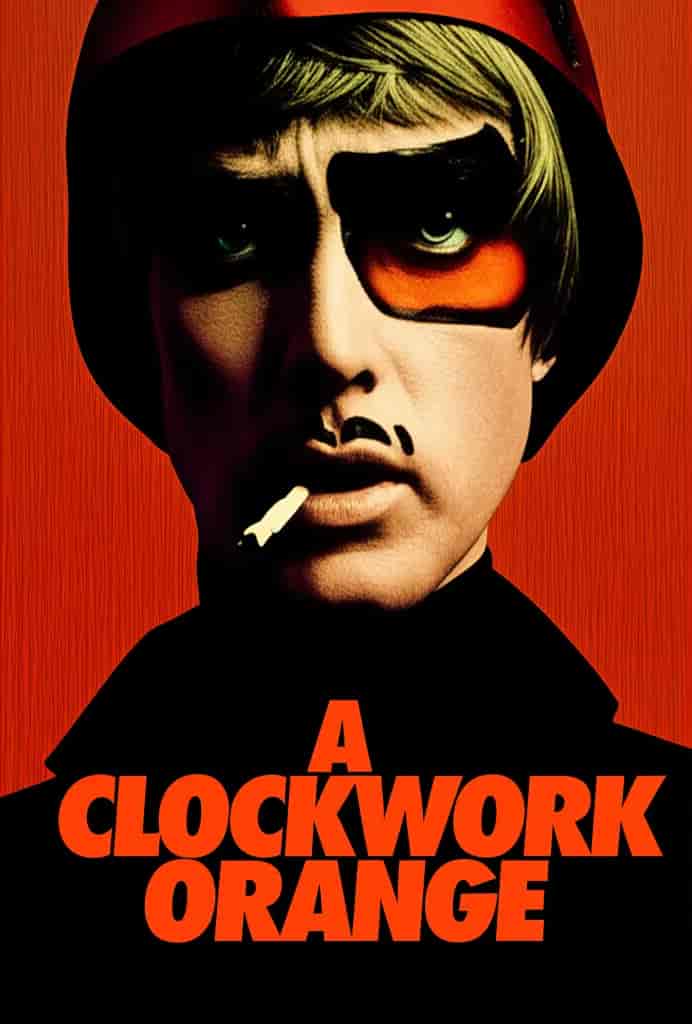
💡The eerie and now-iconic poster of A Clockwork Orange was created by designer Bill Gold, using a cog-eyed and knife-wielding image of Malcolm McDowell that has since become emblematic of the film's themes of dehumanization and violence.
🎯Kubrick’s innovative use of classical music, particularly the electronic rendition of Beethoven's Ninth Symphony by Wendy Carlos, was groundbreaking at the time. This choice not only influenced the film’s disturbing aesthetic but also pioneered the use of synthesized classical music in cinema.
The trivia section is generated with AI assistance for entertainment purposes only. For official information, please refer to the movie's official sources.